
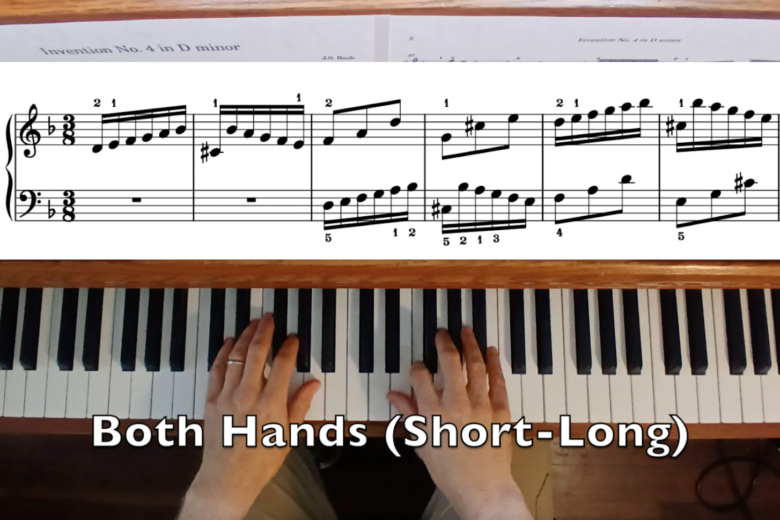
For this week’s video, I demonstrate a piano practice technique called rhythmic variations. I discovered this technique when I was a piano student and have used it enthusiastically ever since. Rhythmic variations help with playing difficult passages and runs, which show up frequently in classical music. Such runs require the piano learner to move their hands quickly and learn ever-changing fingering.
Rhythmic variations are simple to use:
- Select a fast-moving passage of your music for either hand or both hands. These could be sixteenth notes or fast eighth notes.
- Play the passage with either the long-short or short-long variation described in the video below, changing the steady notes into a dotted rhythm.
- Practice repeatedly until you are satisfied.
- Play the passage normally. If this technique is played properly, you will most certainly notice immediate improvement!
Rhythmic variations are a great way to run through each passage thoughtfully and effectively, while building dexterity and speed. This piano practice technique helps difficult passages become more manageable or even eliminates the challenge entirely.
The mindset behind rhythmic variations is the strategic practice approach I use every week to help students break down their music and make progress (See also, “The Most Effective Approach To Piano Practice (Video Lesson)“). I find the strategic approach is the best way to avoid practice ruts, such as starting at the beginning every time (what I call “A-to-Z playing“) or only playing the easy parts.
In my book, “Play Piano: A Learner’s Guide to Playing, Reading, and Creating Music,” I write:
Play Piano A Learner’s Guide to Playing, Reading, and Creating Music, pp.106-7:
Effective practice prioritizes what needs work so we can move forward. Focusing in these areas helps us “polish the silverware,” so to speak. Every bit of “sparkle” we achieve—whether from clarifying the fingering in a tricky passage or learning to count it—is inherently satisfying. The slightest “shine” where before was dirt or a muddled view will raise our spirits and give us satisfaction.
Every week, I see students bringing their playing under greater control and greater mastery, as they “polish” each element. With a focus on small but essential wins, progress inevitably follows. It stands to reason that as long as you practice effectively, your playing will improve. Even if gradual, this process helps bring accuracy, fluency, and expression to your playing.
This is exactly the spirit behind rhythmic variations. Rather than starting from the beginning and hoping to make progress, rhythmic variations go right to the source of the most challenging parts of the music. Almost as if by magic, using this piano practice technique will help transform your playing.