
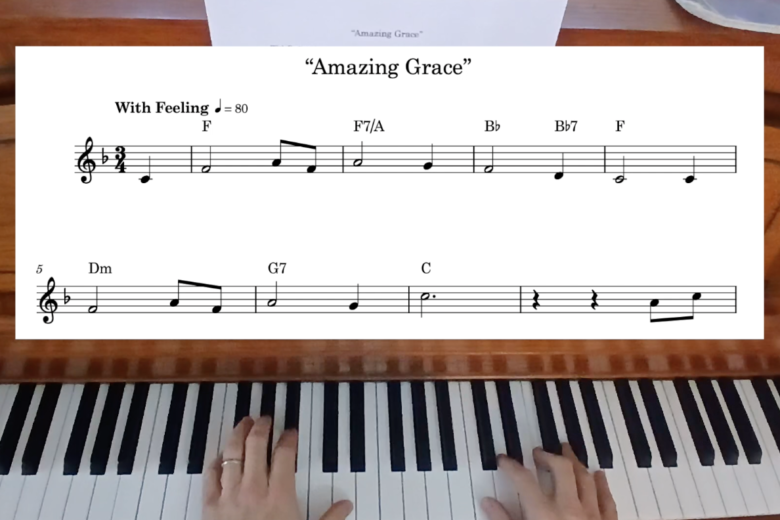
For today’s video, I demonstrate a three-step process for playing a lead sheet. As I described in more detail in a previous post, lead sheets are a convenient way to show the information of a song (See also ‘Lead Sheets vs Piano Sheet Music“). The three steps I describe in today’s video are:
- Learn the melody separately. This involves working out the fingering (which you can write on your page) so you can easily navigate the direction the notes take on the lead sheet. You want to practice it enough so that your fingers start to learn automatically what to play.
- Learn the chords separately. As with the melody, you want to practice your chords enough so that they start becoming automatic. This can take time and plenty of repetition, especially with chords that are new to you. That is okay. Chord practice is an essential skill-building activity, especially for playing lead sheets!
- Be patient in combining both hands. For this you may have to work slowly. Your mind and ear might get impatient, but the delayed gratification will pay off. Slow repetition of both hands at once will become easier, and the song will start to take shape in real time.
There are many benefits to working with a piano lead sheet. For one, they are easier to decipher than a complex sheet of piano music. Of course, there is nothing wrong with sheet music, and many learners are content with it. But some learners want a change from the intense, analytical nature of sheet music. Lead sheets engage the creative brain by inviting choices, from how to play the chords to making creative embellishments of the melody. They encourage coloring outside the usual lines that sheet music present. On the other hand, lead sheets provide a clear structure in terms of the elements of the song.