
For today’s video, I compare two primary ways that piano learners learn to play their music: lead sheets and sheet music.
Lead sheets are succinct summaries of songs. They feature a melody in the treble clef (often including the lyrics if there are any), and chord symbols above. Lead sheets are open-ended. They allow piano learners to work with them at any level, from beginner to advanced. Essentially, to play a lead sheet is to design one’s own unique arrangement of a song.
Sheet music is a complete, note-for-note rendition of songs, featuring exact notes to be played by both hands via the grand staff (treble and bass clef). Because of its meticulous and exact nature, sheet music is designed to be learned precisely, generally giving little wiggle-room for piano learners to adapt the music to fit their level or interests. What you see is what you get.
Sheet music is far more popular than lead sheets to this day, as most piano learners learn to play through the traditional reading approach. Yet increasingly, many piano learners seek out the benefits of lead sheets, which incorporate elements of improvisation (especially through playing chords) to play familiar songs.
From Chapter 11 of my book, “Play Piano: A Learner’s Guide to Playing, Reading, and Creating Music”:
Lead Sheets vs. Sheet Music (Side-by-Side Comparison)
| Lead Sheets | Sheet Music | |
| Clef/s used: | Treble clef | Piano grand staff (treble and bass clef)* |
| Staff looks like: |  | 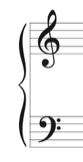 |
| Format and length: | Printed succinctly in 1 or 2 pages, with chords, melody, and lyrics | All musical elements printed on the score, which often requires many pages |
| Ease of use: | Often easier for music readers and improvisers alike | Generally more difficult and time-consuming to decipher |
| Flexibility: | Adapts easily to the tastes, skill level and needs of each pianist | Requires exact adherence to what is on the page |
| Learning Value: | Helps foster many skills, including: –Overall playing skills –Chord-playing skills, from frequently conjuring up chords –Arrangement skills, from making frequent playing choices with both hands –Improvisation skills and overall creativity, from inventing original solos to song chord progressions –Playing-by-ear skills, when recordings are used to fill in details not listed on the lead sheet | Fosters playing and reading-music skills Can be a joyful challenge, requiring focus and detail work Adhering to the score results in an exact and accurate rendition of the music |
* Vocal/piano sheet music has an additional treble clef for the voice.